Attraction
Mohan — the Chinese border town across from Boten
Boten's twin on the Chinese side of the border — modern, fast-growing, and a fascinating contrast to its Lao counterpart.
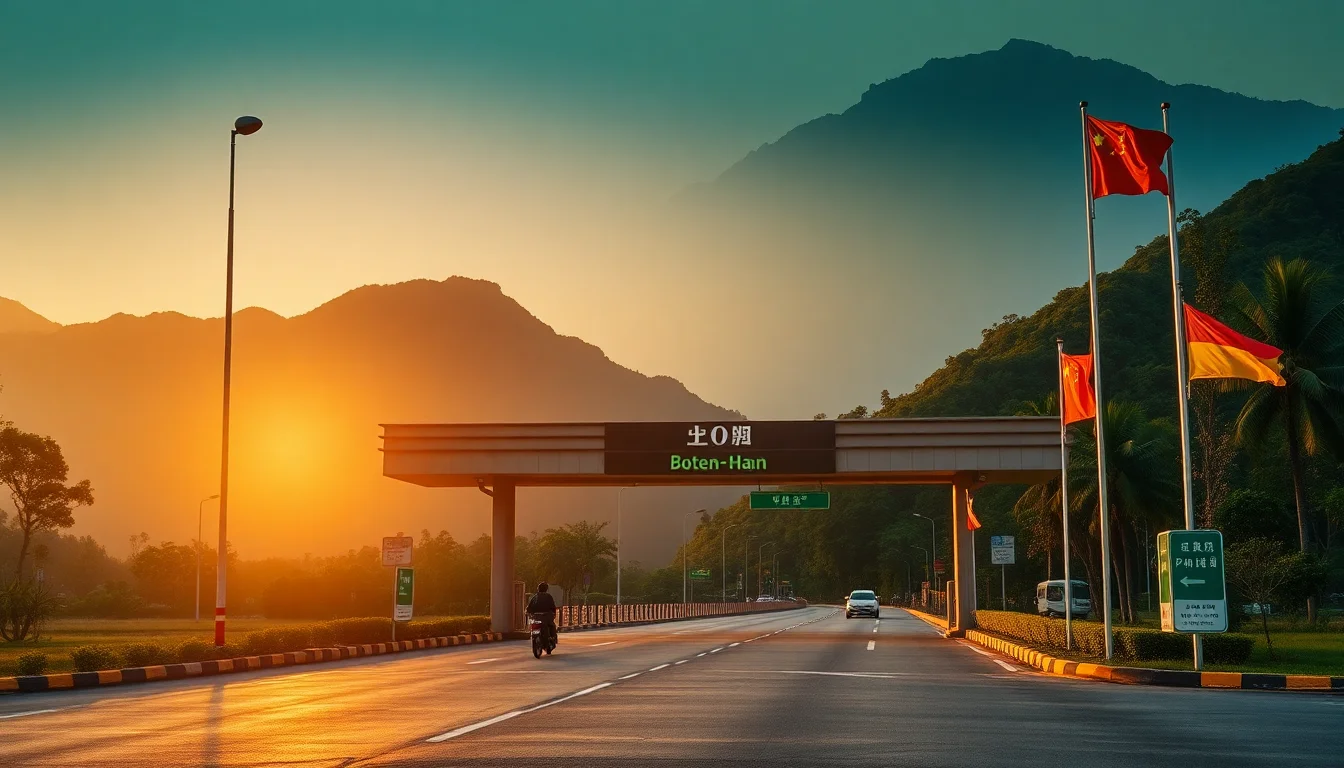
Mohan (磨憨) sits in Mengla County in Xishuangbanna Dai Autonomous Prefecture, Yunnan province, China — directly across the international border from Boten, Laos. Over the past decade, it has grown dramatically from a quiet frontier village into a modern Chinese border town, anchored by the Mohan Railway Station on the China-Laos Railway and the high-volume Boten–Mohan customs facility.
For visitors based in Boten, Mohan is the natural cross-border excursion. Day-trips are common — particularly for travellers who want a taste of Yunnan without committing to a longer mainland China journey. But it requires planning: there is no visa-free transit at the Boten–Mohan land crossing, and Chinese mobile networks, payment systems and language take over the moment you cross.
What's actually in Mohan
Mohan is a Chinese-built modern town. Don't expect the temple-and-ancient-architecture experience of Lijiang or Dali — Mohan is purposeful infrastructure rather than tourist heritage. What's there:
- Mohan town centre — A modern Chinese border-city grid with shops, restaurants, mid-range hotels and a large plaza near the customs building. The architecture is mostly post-2010 and the streets are wide and well-lit.
- Mohan Railway Station — Counterpart to Boten Station, this is the Chinese-side anchor of the China-Laos Railway. The station building is significantly larger than Boten's and serves as a transit hub for visitors continuing north into Yunnan.
- Cross-border markets and shopping — Several large retail complexes within walking distance of the border, with a different product mix from Boten's duty-free (heavier on Chinese consumer goods, lighter on alcohol).
- Restaurants — Yunnan cuisine done well — particularly the Xishuangbanna Dai food specialities. Pineapple rice, banana-leaf-grilled fish, cross-bridge noodles. Several venues open until late.
- Hotels — Mid-range and budget Chinese chain hotels (Hanting, 7 Days, etc.), serving border traders and railway transit passengers.
How to cross from Boten
A valid Chinese visa is required. There is no visa-free transit at the Boten-Mohan land crossing, and the 15-day visa-free transit policy that applies at major Chinese international airports does not apply here. Most travellers obtain a Chinese tourist visa (L visa) in advance from the Chinese embassy in their home country.
Crossing options:
- By train — The cross-border China-Laos Railway service is the smoothest option. Train passengers stay on board until the train reaches Boten Station, complete Lao exit formalities, re-board, then complete Chinese entry formalities at Mohan Station (~60-minute combined dwell time).
- By road — Cross-border buses run from Boten to Mohan and onward to Mengla town. Several scheduled services daily.
- On foot — Walking is permitted between the immigration buildings on either side, but you'll likely want a taxi or shuttle on at least one side. The full walk between Boten village and Mohan town is roughly 6 km.
Day-trip itinerary suggestion
A typical day-trip: morning train from Boten Station (arriving Mohan around 09:30), brunch at a Yunnan restaurant near the station, walking exploration of the central plaza and one of the cross-border malls, lunch, optional onward to Mengla town (40 minutes by Chinese taxi), late-afternoon return train to Boten.
For longer Yunnan exploration, the obvious next step is Jinghong (about 4 hours from Mohan) — the regional Xishuangbanna capital and a much richer cultural destination.
What to know before you cross
- Visa first — Apply for a Chinese tourist visa before you travel to Laos. Multi-entry is worth the extra cost if you plan multiple day-trips.
- SIM / data — Chinese mobile networks have heavy content filtering. Either bring a Chinese SIM or use a roaming plan that supports China. Most foreign apps (Google, Gmail, WhatsApp, Instagram) won't work without a VPN.
- Payments — Alipay and WeChat Pay dominate; cash is sometimes refused outright in modern shops. Set up Alipay's "Tour Pass" before crossing if you don't have a Chinese bank account.
- Language — Mandarin is essential. English is very limited. A translator app with offline Chinese is invaluable.
- Customs — Standard restrictions on agricultural products, large amounts of cash (declare amounts above US$10,000 equivalent), and certain electronics.
For more on the border itself, see our history of Boten. For the southern alternative to Mohan crossings, see the railway's broader attractions network.
→ See also: All Boten attractions · Hotels in Boten · Boten restaurants